Best AI Language Learning Apps in 2026 (Ranked & Reviewed)
Duolingo vs Babbel vs Pimsleur compared — which AI language learning app actually gets you to fluency fastest?

Language learning has been transformed by AI. Adaptive algorithms now adjust difficulty in real time, speech recognition gives instant pronunciation feedback, and personalization means every lesson targets your specific gaps.
Here’s how the three biggest AI language learning apps compare.
Quick Comparison
| Tool | Best For | Languages | Pricing |
|---|---|---|---|
| Duolingo | Beginners, habit-building | 40+ | Free · Super $7/mo |
| Babbel | Conversational skills | 14 | From $7/mo |
| Pimsleur | Speaking confidence | 50+ | From $14.95/mo |
1. Duolingo — Best for Beginners
Pricing: Free · Duolingo Super $6.99/mo · Max $13.99/mo
Duolingo is the most downloaded education app in the world for good reason. Its gamification — streaks, XP, leagues, animated characters — makes daily practice genuinely enjoyable. For beginners who struggle to build a consistent habit, Duolingo’s system is unmatched.
The AI now powers personalized review, conversation practice with an AI tutor (Max plan), and adaptive difficulty. The lessons are short (3-5 minutes), making them easy to fit in anywhere.
For popular languages (Spanish, French, German, Japanese), the courses are deep and well-structured. For rarer languages, quality varies.
Limitation: Heavy gamification can feel shallow. Advanced learners often find it too easy and not focused enough on production.
Best for: Absolute beginners, people who struggle with consistency, anyone who wants to try language learning for free.
→ See Duolingo details and pricing
2. Babbel — Best for Conversational Skills
Pricing: Monthly $14.95 · Annual $83.40 ($6.95/mo)
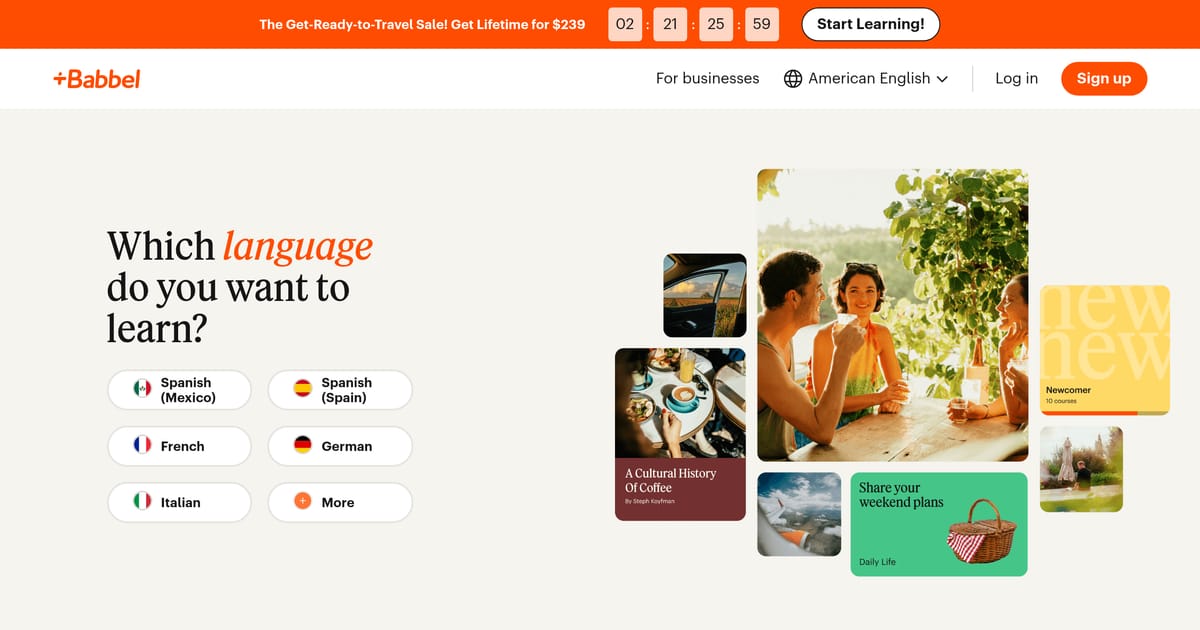
Babbel is designed by linguists with one goal: get you speaking real conversations as fast as possible. Lessons are scenario-based (“at the airport,” “meeting a colleague,” “ordering food”) and use AI speech recognition to correct your pronunciation immediately.
The structured curriculum is more rigorous than Duolingo — lessons build on each other in a logical sequence rather than scattering topics across levels. Most learners reach confident A2-B1 conversational ability within 3-6 months of consistent use.
14 languages only — but all are done well. No filler languages with thin content.
Best for: Motivated adults who want practical conversation skills, travelers, professionals learning for work.
→ See Babbel details and pricing
3. Pimsleur — Best for Speaking Confidence

Pricing: Premium $14.95/mo · All Access $20.95/mo
Pimsleur’s method is unique: you never look at text. Lessons are 30-minute audio programs built on a spaced repetition system — a voice asks you a question in English, waits, then gives you the answer in the target language. You speak out loud, and the AI adjusts what you hear based on your confidence ratings.
The approach produces remarkably fast speaking ability. After 30 lessons (one month), most learners can hold basic conversations. The audio-first method also means you develop an ear for the language, not just reading skills.
Limitation: Expensive per language. No writing practice. Vocabulary breadth is narrower than Babbel or Duolingo.
Best for: Commuters, audio learners, people who want to speak confidently before they can read well.
→ See Pimsleur details and pricing
How to Choose
Just starting out and need motivation: Duolingo
Want real conversational ability fastest: Babbel
Audio learner or always on the go: Pimsleur
Tight budget: Duolingo free tier
Browse all AI Language Learning tools or explore the full AI Learning category.
Questions people ask
What is the best AI language learning app in 2026?
Duolingo is the best for beginners who need motivation and habit-building. Babbel is better for learners who want real conversational skills faster. Pimsleur is best for audio learners and people who want to speak confidently without focusing on reading or writing first.
Can you actually become fluent using an app?
Apps alone rarely produce full fluency — they're excellent for building vocabulary, grammar foundations, and listening comprehension, but conversational fluency requires speaking practice with real people. Apps work best as a daily supplement to other study methods like conversation exchange, tutoring, or immersion.
Is Duolingo enough to learn a language?
Duolingo is excellent for reaching A2-B1 level (basic conversational ability) in popular languages. For B2+ fluency, most learners need additional resources. The gamification keeps daily practice consistent, which is the most important factor in language learning. Studies show Duolingo's Spanish and French courses are equivalent to a university semester.
Which language app is best for busy adults?
Pimsleur's 30-minute audio lessons are designed for commutes and multitasking — you learn while driving, walking, or exercising. Babbel's structured 10-15 minute lessons fit easily into a lunch break. Both are better for busy adults than Duolingo's game-style micro-lessons.
Tools mentioned
The toolbox

Send this to someone who's confused about AI.
It takes one tap, and they get the version without the hype.