On this page
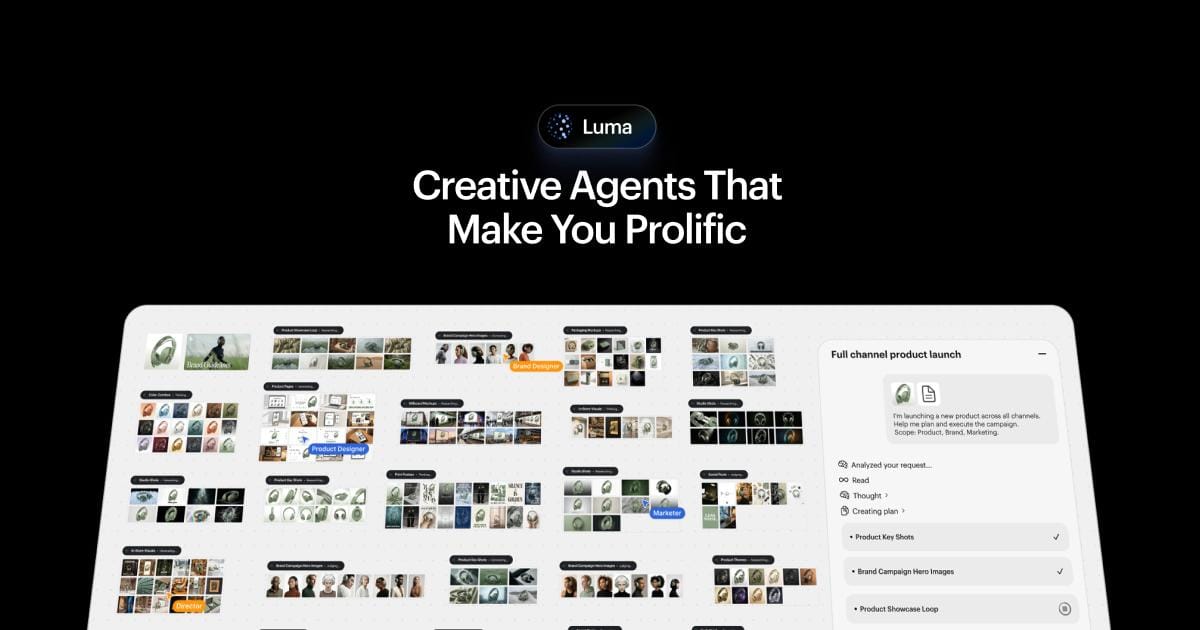
Luma Dream Machine is the video-generation product from Luma AI, a San Francisco lab known earlier for 3D/NeRF capture work. It turns text prompts and still images into short video clips, and its later Ray2 model is the main draw — it produces fluid, natural movement and handles physics and multi-object scenes more convincingly than many earlier text-to-video tools.
In a field that includes OpenAI’s Sora, Runway Gen-3/Gen-4, Kling, and Google’s Veo, Dream Machine competes on speed and motion quality wrapped in a simple interface. Generations typically finish in a couple of minutes, and features like keyframes (set a start and end image and let it interpolate) and camera-motion controls give creators more direction than a plain prompt box. There’s also an API for teams building video generation into their own apps.
Key Features
- Text-to-video and image-to-video with the Ray2 model
- Keyframe control — set start/end frames and interpolate between them
- Camera-motion controls (orbit, push in, pull out, pan)
- Fast generations, often under a couple of minutes
- Extend and loop options for longer or seamless clips
- Developer API for programmatic generation
Pricing
- Free: A small number of watermarked generations per month
- Standard / Plus: ~$30/month for more generations and higher resolution
- Pro / Unlimited: ~$100/month for higher volume and priority
- Premier: Several hundred/month for the largest quotas and commercial use
Best For
Social-media creators, marketers, and filmmakers who want quick, good-looking clips with believable motion — product shots, animated stills, and short cinematic sequences — without long render waits.
Limitations
Clips are short and can lose coherence on busy or highly specific prompts, so results often take several attempts. The free tier watermarks output and caps generations, and while motion is a strength, precise prompt following still lags the strongest closed models like Sora and Veo in some scenarios.